The right ski pants depend on how and where you ski. For cold, lift-served resort days, insulated waterproof trousers often make sense. For warmer conditions or uphill touring, an uninsulated shell with good ventilation offers more flexibility. Ski bibs add snow coverage around the waist, while a well-fitting pair of trousers is simpler to put on and remove.
Before choosing, narrow the decision to four questions: How wet or cold will it be? How much time will you spend moving uphill? Do you prefer a bib or waist-height trousers? And can you bend and turn comfortably while wearing your actual ski boots and base layers?
Which ski pants suit your skiing?
| Your conditions | A sensible starting point | What to check |
|---|---|---|
| Cold resort days and frequent chairlifts | Insulated, waterproof-breathable ski trousers | Warmth, sealed seams, gaiters, waist fit |
| Mild spring skiing | Uninsulated shell trousers | Ventilation, layer flexibility, weather protection |
| Powder and frequent falls | High-waisted trousers or ski bib | Snow coverage, fit, bib straps, accessible pockets |
| Ski touring and uphill travel | Breathable shell or weather-appropriate softshell | Vents, freedom of movement, packability |
| Occasional family ski holiday | Comfortable resort trousers with appropriate protection | Boot fit, ease of use, budget, durability |
These are starting points, not rigid rules. A skier who runs cold may prefer extra warmth, while someone who overheats during easy runs may be happier with a shell.
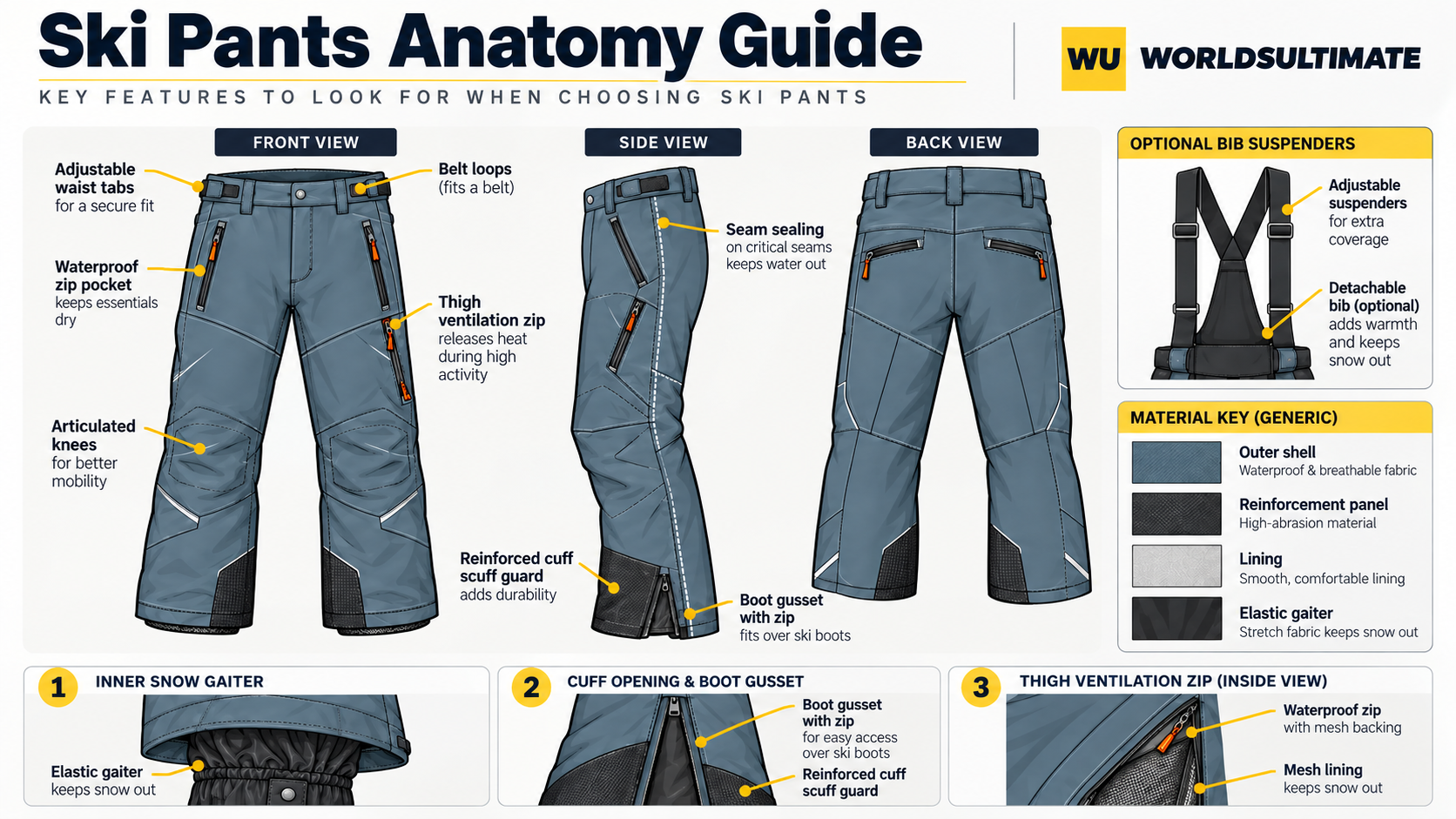
Ski pants, ski bibs, hardshells and softshells
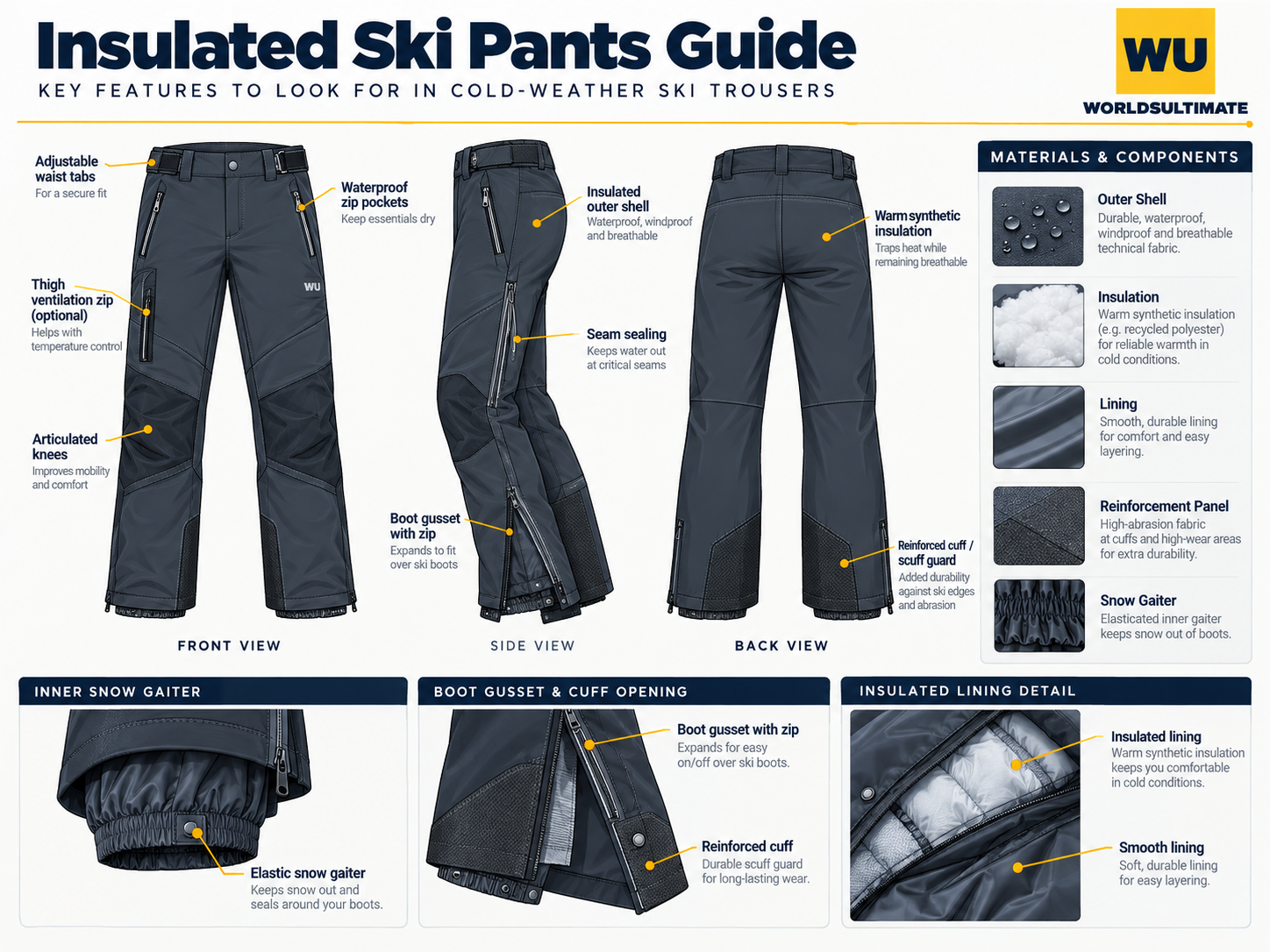
Insulated ski pants
Insulated ski trousers combine an outer protective fabric with synthetic insulation or a warm lining. They can be comfortable when a lot of your day is spent riding lifts, taking lessons or skiing slowly in cold weather. Their drawback is limited flexibility: if you get too warm, you cannot remove the insulation built into the garment. Insulation weights vary by model, and fill weight alone does not establish warmth; overall construction, wind exposure, fit and your own activity also matter.
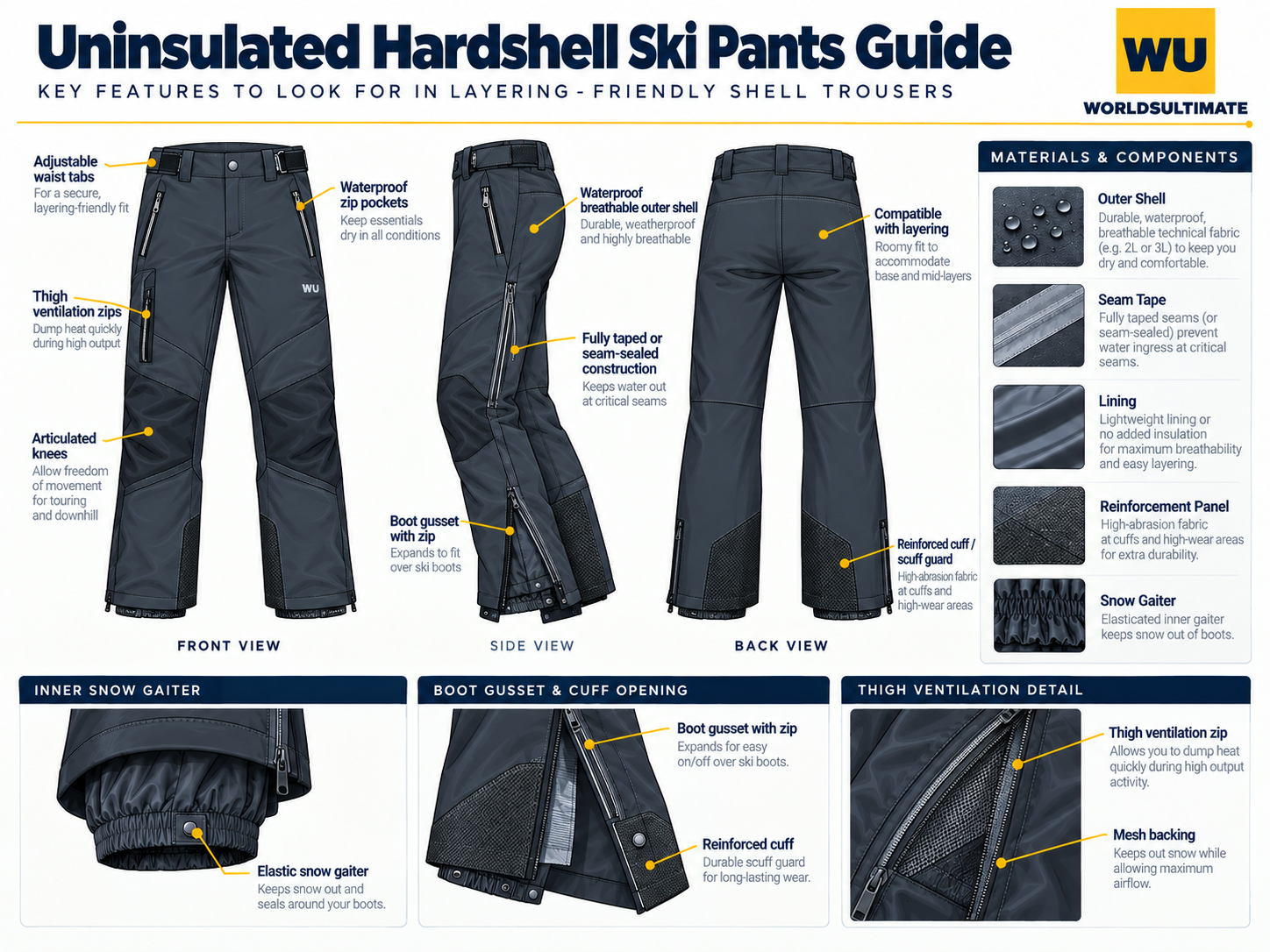
Uninsulated hardshell pants
A hardshell focuses on blocking wind and precipitation, with thermal comfort supplied by separate layers. That makes it useful when temperatures vary or you move between resort skiing and more energetic activity. Shell trousers can be worn over thin thermals in spring and warmer layers in midwinter. They still need a comfortable fit and adequate ventilation—waterproof fabric alone will not prevent sweat buildup.
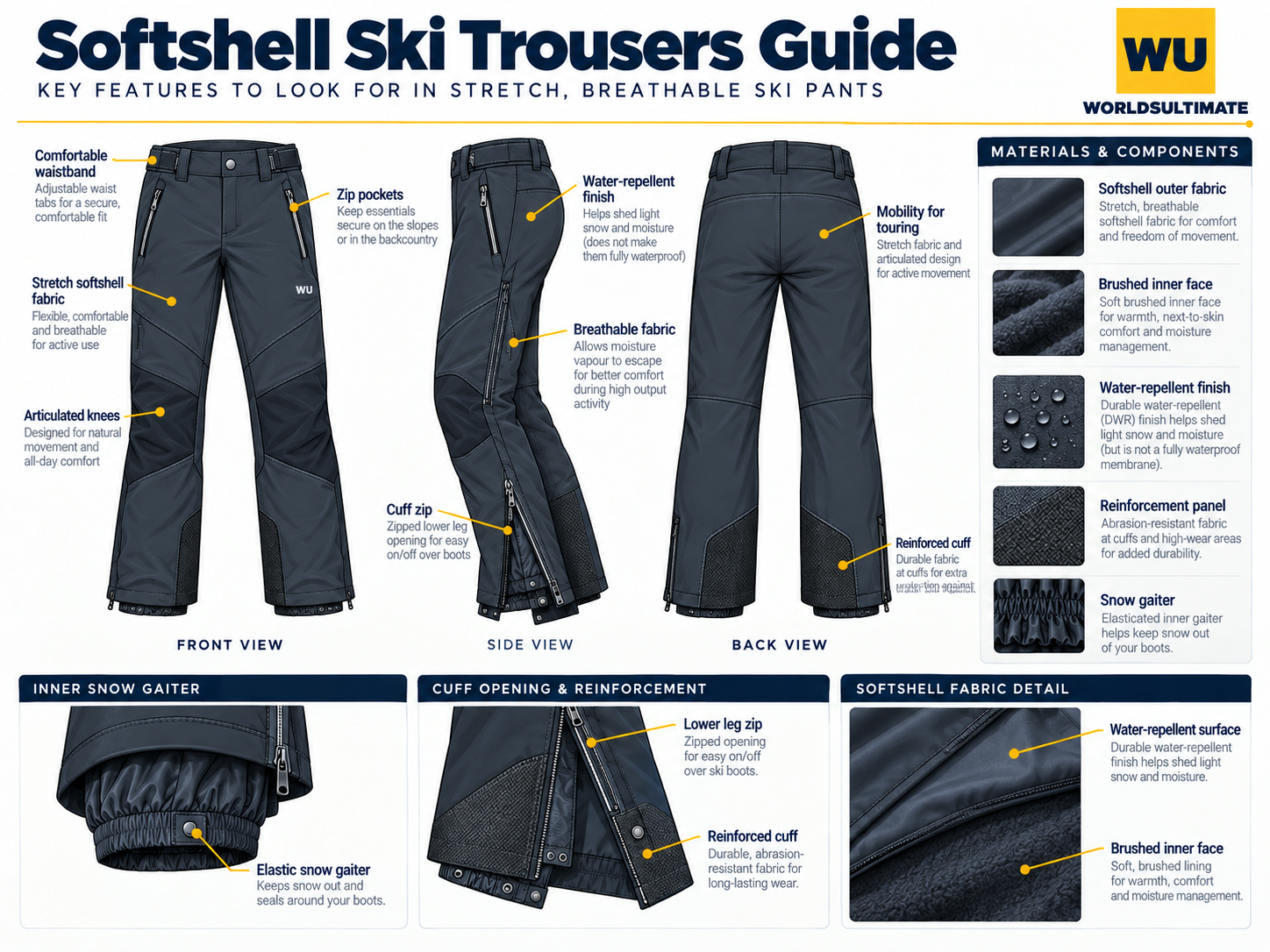
Softshell ski trousers
Softshell fabrics usually prioritise stretch, air movement and comfort, which can make them attractive for touring or relatively dry conditions. They are not automatically waterproof: some offer strong weather resistance, while others are mainly wind-resistant with a water-repellent finish. Check the actual fabric and seam construction rather than relying on the word ‘softshell’.
Ski bibs versus waist-height trousers
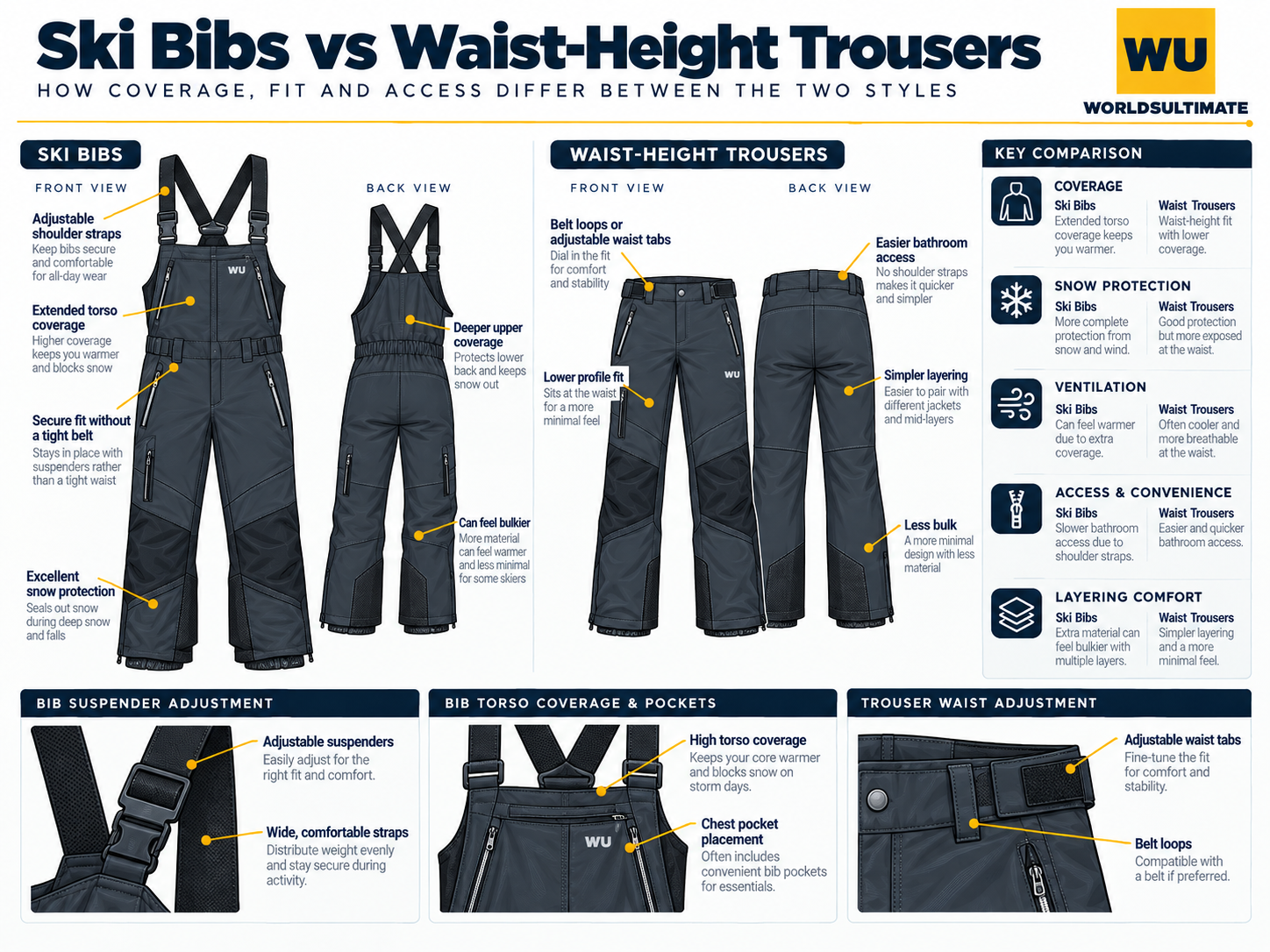
Bibs extend above the waist and use shoulder straps. The additional coverage makes it harder for snow to enter around the waistband during a fall or in deep powder. They can also sit securely without a tight belt. Ordinary trousers are generally easier to remove and can feel less bulky. With a bib, pay attention to torso length, strap adjustment, bathroom access and whether pockets remain usable under a jacket or backpack.
Waterproof ratings: what 5K, 10K and 20K mean
Many ski-clothing labels describe waterproofing as a hydrostatic-head rating in millimetres. The ISO 811:2018 fabric-test standard defines a hydrostatic-pressure method for assessing resistance to water penetration; ISO confirmed this edition remained current in its 2025 review. In a standardised pressure test, a higher number generally indicates greater resistance to water penetration. It does not, by itself, guarantee that the finished trousers will keep you dry: seams, zips, abrasion, construction and ongoing care also matter.
| Advertised rating | Practical interpretation | Important qualification |
|---|---|---|
| 5,000 mm (5K) | Lower stated resistance to water pressure | May be insufficient for sustained wet conditions |
| 10,000 mm (10K) | Mid-range stated protection | Construction and seam sealing still matter |
| 15,000–20,000 mm | Higher stated resistance to water pressure | Useful to compare, but test methods and fabric build vary |
| Over 20,000 mm | Often found on technical waterproof shells | Not a guarantee of comfort or superior breathability |
Treat these as broad comparisons rather than hard performance thresholds. A higher fabric rating can be undermined by unsealed seams or damaged waterproof layers. Wet chairlift seats, kneeling in slush and long spells of heavy snow create different demands than dry powder.
Membranes, DWR and taped seams
A waterproof membrane or coating provides the main barrier to liquid water. Durable water-repellent (DWR) treatment is applied to the outer face so droplets roll away rather than saturating the fabric. DWR can wear off; losing the beading effect does not necessarily mean the membrane has failed, but a soaked outer fabric can feel colder and may affect comfort.
Fully taped seams protect the stitching throughout the garment. Critically taped seams cover selected high-exposure areas. For frequent wet-weather skiing, inspect these details rather than accepting an unqualified ‘waterproof’ claim. Also examine zip flaps, pocket closures and lower-leg construction.
Breathability and why ski pants can feel wet inside
Breathability describes how easily moisture vapour escapes through fabric. Manufacturers may provide a moisture-vapour transmission rate (MVTR), often expressed in g/m²/24h, or a resistance-to-evaporative-heat-transfer (RET) figure. The current ISO 11092:2026 standard describes the sweating-guarded-hotplate method for measuring textile thermal and water-vapour resistance. With MVTR, higher results generally signal more transfer within the same test; with RET, lower values indicate less resistance. Because laboratories use different procedures, these numbers are not always directly comparable across brands.
Even highly breathable membranes can feel clammy during a steep climb. Wide thigh vents and sensible layering often make a larger practical difference than a marketing claim. For ski touring, check where vents sit, whether they open with gloves and whether a backpack or harness covers them.
What a ski instructor advises about clothing
Ed Zebrowski, a longtime ski instructor and coach interviewed for a published snow-clothing guide, explains how weather can change dramatically within a single ski day. His practical emphasis is on choosing layers that adapt to the conditions rather than relying on one outfit for every temperature.
For ski pants, consider whether adjustable base layers and a shell would be more useful than fixed insulation. Insulated trousers may suit consistently cold, less active days, while vents and separate layers allow greater adjustment during demanding skiing. This summarises Zebrowski’s published advice; he was not interviewed by WorldsUltimate.
How much insulation do you need?
There is no single insulation weight suitable for everyone. A skier riding chairlifts in freezing wind may benefit from built-in synthetic insulation. A skier hiking uphill can generate considerable heat and may prefer a thin base layer beneath a shell. Wind exposure, humidity, how much you sweat and the time spent stationary all influence comfort.
A moisture-managing base layer is usually more useful against the skin than cotton that stays wet when you perspire. The CDC’s National Institute for Occupational Safety and Health recommends clothing layers that can be adjusted to activity, freedom of movement and protection against wet clothing in cold environments. Its guidance addresses cold-weather work rather than testing individual ski garments. On particularly cold days, an additional thermal layer may help beneath a shell, provided there is enough room to move. Our what to wear skiing guide covers the wider clothing system.
Getting the fit right: a practical try-on checklist
Try ski pants with the thermals and ski boots you expect to wear, rather than judging fit over ordinary shoes. Bend your knees into a skiing position, squat, step up and sit down. The waistband should not dig into your stomach, and the fabric should not pull tightly across the hips or crotch.
Check that the knees remain free to bend and the hem falls appropriately over the boots without dragging beneath them. Ski trousers can have regular, relaxed or slim cuts, but those labels vary by manufacturer. Short and long inseam options can improve fit without forcing you into the wrong waist size.
Men’s, women’s and children’s fits
Women’s and men’s sizing systems often differ around the waist, hips, rise and leg shape. Prioritise the actual size chart and movement over the marketing category. For children, allow suitable comfort and room for layers without leaving so much extra length that cuffs catch under boots. Adjustability can help accommodate growth, but oversized outerwear can interfere with movement.
Features worth paying attention to
| Feature | Why it matters |
|---|---|
| Snow gaiters | Inner cuffs that sit over boots and help reduce snow entry |
| Reinforced hems or scuff guards | Protect high-wear lower-leg areas against boots and ski edges |
| Thigh ventilation zips | Release heat when skiing hard or walking uphill |
| Articulated knees or gussets | Allow bending and turning without pulling the fabric tight |
| Adjustable waistband or bib straps | Help secure the fit with different base layers |
| Zipped pockets | Help keep small items secure during movement |
| Jacket-to-pant attachment | Can reduce gaps at the waist where compatible |
| Accessible bathroom openings on bibs | Can make a big difference during a full day on snow |
No one needs every feature. A resort beginner may value simple adjustments and secure boot gaiters; a touring skier may prefer long vents and low bulk. Prioritise what changes your actual skiing experience.
Resort skiing, freeride and touring: different demands
Lift-served resorts
For groomed slopes and lessons, choose warmth and dependable protection for the weather you expect. Sealed seams, comfortable insulation and snow gaiters matter when spending time on lifts or falling in soft snow. You may not need the lightest or most technical three-layer shell.
Powder and freeride days
Deeper snow makes waist coverage, cuffs and the jacket-to-trouser interface especially important. Bibs are popular here, but carefully fitting trousers with a secure waist can also work. Strong weather protection and freedom to crouch are worth prioritising.
Backcountry touring
Touring involves climbing, variable temperatures and longer exposure. Ventilation, low bulk and layering flexibility can become as important as weather resistance. Clothing choices do not replace mountain-safety planning, avalanche education or appropriate equipment.
How to care for waterproof ski pants
Follow the garment’s care label, including instructions for technical detergents, drying temperature and water-repellent treatment. Dirt, oils and detergent residues can interfere with performance. Some garments allow gentle heat to reactivate an existing DWR finish; others require different care, so do not apply a generic high-heat method.
Check hems, seams, gaiters and zips after each trip. Repair damage according to manufacturer guidance, and store clothing completely dry. A well-maintained older pair can be a better choice than new trousers with a poor fit.
Mistakes to avoid when choosing ski pants
The most common mistakes are treating waterproof numbers as the entire story, assuming all bibs are insulated, buying a larger size to compensate for a restrictive cut, ignoring vents, and forgetting to test trousers over actual ski boots. Another mistake is treating DWR coating as proof of a fully waterproof garment.
Consider how often you ski before paying for technical features. High-end shells can be worthwhile for frequent mountain use, but occasional resort trips may be well served by simpler, correctly fitted outerwear.
Frequently asked questions
Are ski pants supposed to be baggy?
They need enough room for a skiing stance and planned layers, but not so much material that cuffs catch under boots or fabric bunches uncomfortably. The best cut varies by body shape and activity.
Can you ski in ordinary waterproof trousers?
Some waterproof outdoor trousers may work in limited conditions, but many lack snow gaiters, reinforced cuffs, movement-oriented fit and boot compatibility needed for regular skiing.
Do ski bibs keep you warmer?
They offer more coverage around the torso, but warmth depends on their fabric, insulation and the layers underneath. An uninsulated bib is not automatically warmer than insulated trousers.
Do you wear anything under ski pants?
Usually a suitable moisture-managing base layer, with extra thermal protection when temperatures require it. Avoid unnecessary bulk that restricts circulation or movement.
How long should ski trousers be?
They should cover the top of the ski boots and work with their gaiters without dragging beneath the soles. Check length with boots on and knees bent, not only while standing.
What is better for beginners: bibs or pants?
Neither is universally better. Ordinary trousers may be simpler for frequent indoor breaks; bibs offer extra snow coverage during falls. Comfortable fit, suitable warmth and weather protection matter more.
More skiing equipment advice
Explore ski boot fit and flex, ski clothing and layers, and skiing versus snowboarding for connected beginner decisions.