The best classic cars are remembered for more than age: their design, engineering, racing history and lasting influence. This illustrated guide brings together 36 memorable models, from the Ford Model T and Mercedes-Benz 300 SL to the Jaguar E-Type, Ferrari 250 GTO and 1980s performance cars. It is a curated selection, not a claim that every classic is valuable or that the models can be ranked objectively.
What makes these classic cars stand out?
We selected vehicles for distinct historical significance, influential styling, technical innovation, cultural reputation or motorsport importance. The list spans decades, and model years are checked against manufacturer heritage where possible. How old a car must be to count as classic is a separate question that varies by country, insurer and collector organisation. For market values, consult Hagerty’s condition-specific valuation data rather than assuming every classic appreciates.
The entries are grouped for browsing rather than ranked by price or desirability. Several original photographs depict individual example cars, so a caption year may describe that photographed model rather than the date the entire model family launched.
[toc]
Explore the names and images below to see how classic grand tourers, sports cars, American muscle and affordable enthusiast cars each shaped automotive history.
Classic cars from the early motoring era through the 1970s
Here we take a quick look at the list of classic cars and the top automobiles that have won the hearts of people and continue to do the same today.
1969 Maserati Ghibli 4.7

Giorgetto Giugiaro designed Maserati’s original Ghibli as a front-engined Italian grand tourer, with the 4.7-litre V8 among its defining specifications. A 1969 Ghibli reflects the period when distinctive low-slung styling and long-distance performance began to coexist in increasingly sophisticated European GT cars. For the manufacturer’s model-family history, consult Maserati’s classic-car archive. Individual 4.7-litre, 4.9-litre SS and Spyder versions should not be treated as technically identical.
Classic Car Modification: Expert Tips
If you are a car lover, then customizing the best classic cars is something you would want to do. Whether you are working to return an old beauty to its root or giving it a modern makeover, vintage car customization will provide a new lease of life to an old device.
At the rear, there were some outstanding features which includes a single longitudinal torque arm with a live axle on semi-elliptic springs, hydraulic dampers, and an anti-roll bar. Also, the magnesium wheels were standard. Whereas, the Maserati fitted the car with two independent 50 L fuel tanks, which could be filled through flaps.
1967 Chevrolet Camaro — first model year

The Chevrolet Camaro reached the market in September 1966 as a 1967 model, created to compete in the rapidly expanding pony-car class. Chevrolet offered several engines and trims, including SS and Z/28 performance packages; neither all first-year Camaros nor all first-generation Camaros had a big-block V8. GM’s model-year history.
Offered in multiple trims, from the iconic SS to the Z/28 models, it delivered both performance as well as style to a generation of car enthusiasts. With a unique look and an even more distinctive roar coming out of its engine, it cemented its place in American pop culture. It earns the status as a classic for muscle car enthusiasts and collectors alike.
Mercedes-Benz 300 SL Gullwing (1954–1957)

Mercedes-Benz introduced the production 300 SL (W 198) at the New York show in February 1954. Its roof-hinged gullwing doors were a consequence of the high tubular spaceframe sills, not merely a styling flourish. The production Coupé used fuel injection and a 3.0-litre straight-six; Mercedes-Benz says 1,400 Coupés were built between 1954 and 1957. Mercedes-Benz heritage record.
An important distinction: this road-going 300 SL is not the two-example 300 SLR Uhlenhaut Coupé, whose record auction is covered separately. The 300 SL’s significance lies in bringing racing-derived lightweight construction and direct petrol injection to a production sports car.
Jaguar E-Type — introduced in 1961

Jaguar unveiled the E-Type on 15 March 1961 in Geneva. Its low, sculpted shape, independent rear suspension and remarkable performance helped make it a defining British sports car. Jaguar’s heritage trust documents the launch journey of the original Geneva display Coupé, registration 9600 HP. Jaguar Daimler Heritage Trust.
1966 Shelby 427 Cobra

The Shelby Cobra combined British AC sports-car underpinnings with Ford V8 power, creating a lightweight Anglo-American performance icon. A standard 427 Cobra must not be conflated with the exceptionally rare supercharged “Super Snake” cars: twin Paxton superchargers were not standard equipment on all 427 Cobras. See Shelby American’s history for the development context.
1958 Chevrolet Impala

Chevrolet introduced the Impala for 1958 as an upper-range model with its own styling and trim identity, before reworking it dramatically in 1959. The 1958 model is known for its broad stance and triple tail lamps; its engine and power depend on the exact version ordered. Chevrolet’s Impala heritage.
1967 Ford Mustang — first-generation pony car
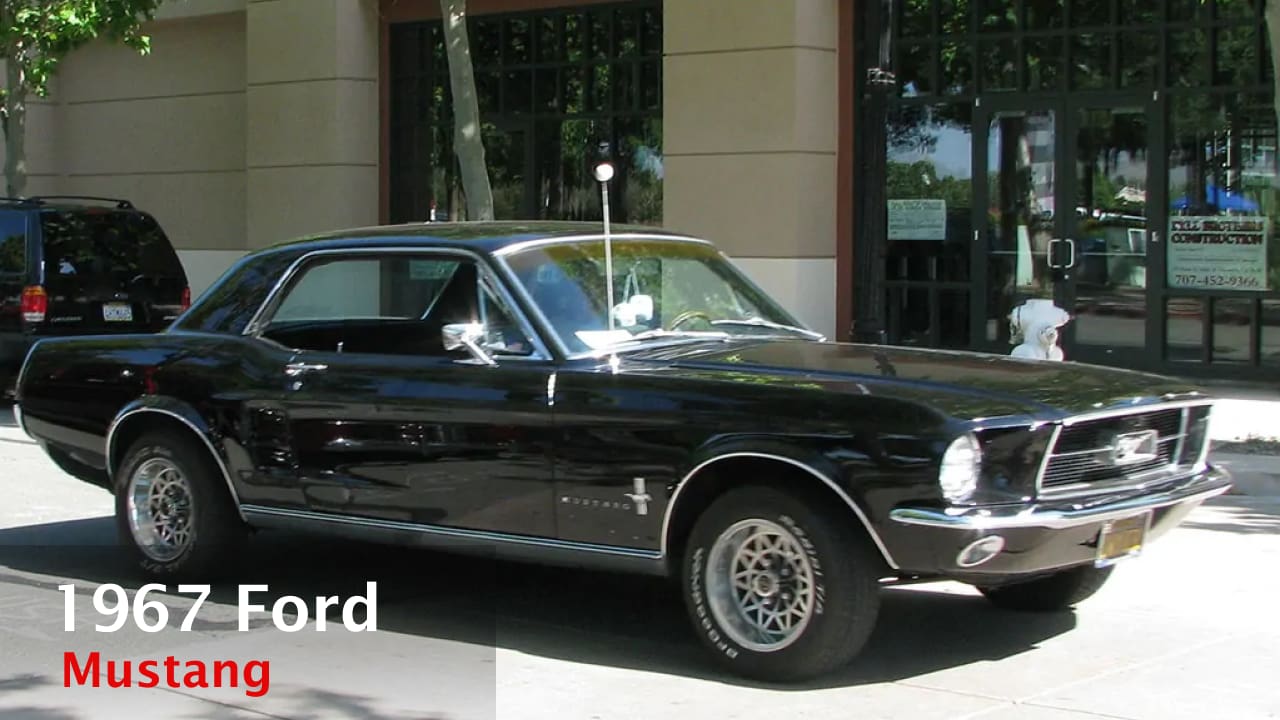
Ford introduced the Mustang in April 1964, creating the affordable American pony-car formula through a long bonnet, short rear deck and extensive personalisation. The 1967 version was a later first-generation evolution with a larger body and more powerful engine options; engine specification varied by trim. Ford’s Mustang history.
1969 Corvette Stingray

The 1969 Corvette is part of the third-generation C3 series, introduced for 1968. Its long bonnet and dramatic bodywork were inspired by the Mako Shark II concept. The famous split rear window belongs to the 1963 Sting Ray Coupé, not the 1969 model. Chevrolet’s own timeline separates the 1963–67 C2 from the 1968–82 C3. Chevrolet Corvette heritage.
Tucker 48 (1948) — 51 built

The Tucker ’48 is remembered for its unusually ambitious postwar design and for the collapse of the company behind it. The Tucker Automobile Preservation Society records 51 examples built; it also notes that the production car was called Tucker ’48 rather than Tucker Torpedo, the name used during development. Tucker preservation society history.
Porsche 911 — unveiled in 1963; production began in 1964

Porsche unveiled its new rear-engined six-cylinder sports car as the 901 in September 1963. Series production began in September 1964, and the model was renamed the 911 following a naming-rights challenge from Peugeot. This continuity of concept, with decades of continuous evolution, makes the early 911 one of the most influential classic-car families. Porsche’s 60-year history.
Aston Martin DB2 (1950–1953) — original DB2 grand tourer

Aston Martin’s DB2 entered series production in 1950 with a twin-cam straight-six engine originating from Lagonda, then helped establish the post-war David Brown-era grand-tourer identity. The DB2/4 was a related successor introduced in 1953, so specifications for the two must not be treated as interchangeable. Aston Martin DB2 heritage; DB2/4 heritage.
Maserati 3500 GT / GTI (1957–1964)

Maserati’s 3500 GT, launched in 1957, helped move the company towards road-going grand tourers after it withdrew from factory motor racing. Touring’s Superleggera coachwork wrapped aluminium panels over a steel framework, and the later injected 3500 GTI arrived in 1961. Maserati documents the model family’s 1957–1964 production period and different technical specifications for GT and GTI. Maserati Classics.
Volkswagen Beetle — a 1967 example of the long-running Type 1

The 1967 Volkswagen Beetle is an example of the much longer-running Type 1 series, not its debut year. Volkswagen’s records note that revised 1967/68 Beetle 1500 versions brought changes such as 12-volt electrics and front disc brakes in some variants, with important differences among domestic and US-market cars. Volkswagen Newsroom.
1969 Camaro SS

The 1969 Camaro SS belongs to the first Camaro generation and represents a more muscular approach to performance and personalisation. SS and Z/28 were different packages, and power output varied by engine rather than coming from one single universal specification. Chevrolet’s heritage records describe the restyled 1969 bodywork and available upgrades. Chevrolet’s model-year timeline.
Nissan Fairlady Z / Datsun 240Z (S30) — introduced in 1969

Nissan launched the original Fairlady Z / Datsun 240Z S30 in 1969, not 1977. The sports coupé combined accessible pricing, six-cylinder performance and practical grand-touring ability, helping establish Japan as a global sports-car contender. Regional naming and engine specifications differed: the Japanese Fairlady Z and export 240Z were related, but not mechanically identical in every market. Nissan’s 50-year Z history.
The S30 generation ran through the 1970s; individual cars therefore carry model years well after the 1969 introduction. This list refers to the original generation, rather than treating a pictured 1977 example as the launch of the whole range.
Mercedes-Benz 450 SEL 6.9 — introduced in 1975

The 450 SEL 6.9 arrived in May 1975 as the high-performance flagship of Mercedes-Benz’s W116 S-Class, using a large-capacity V8 and sophisticated suspension. This is a specific long-wheelbase saloon, not a generic “Mercedes-Benz 450” model. Mercedes-Benz dates the debut to May 1975 and distinguishes it from the lesser-engined W116 versions. Mercedes-Benz model history.
Discover the World’s Most Expensive Cars
Automobiles like Mercedes-Benz 300 SLR and Ferrari 250 GTO are to quench the thirst of elites for luxury. We all know that luxury and class doesn’t come without expense. So, let’s explore…
More classic cars: historic icons and 1980s favourites
When it comes to the best cars of the 80’s the new generation may become confused and wonder. But, in the 80’s there are some outstanding cars. Those are still famous for their quality, performance, and style and has rule the world for several years.
Let’s find out best classic cars of the 80’s with their features and other details.
Audi quattro (1980–1991) — all-wheel-drive pioneer

The original Audi quattro was unveiled at Geneva in March 1980 and remained in production until May 1991. Its permanent all-wheel-drive layout, turbocharged five-cylinder engine and rally successes changed how performance cars were understood. Audi’s anniversary record identifies two World Rally Championship manufacturers’ titles and two drivers’ titles. Audi Tradition archive.
Ferrari 250 GTO (1962–1964) — racing homologation icon

Ferrari built the 250 GTO as a 1962–64 homologation grand tourer, with its three-litre V12 and streamlined bodywork developed for competition. It is historically significant because of its racing pedigree and exceptional scarcity, not simply because collectors have paid extraordinary sums. Ferrari’s official model history. A reported $70 million private transaction in 2018 is not an auction record and should not be treated as a current valuation.
Mercedes-Benz 300 SLR Uhlenhaut Coupé (1955) — two prototypes

The 1955 Mercedes-Benz 300 SLR Uhlenhaut Coupé was a racing-derived prototype, with just two built. It is separate from the production 300 SL Gullwing above. One of the two sold for €135 million in 2022 at a Mercedes-Benz auction organised by RM Sotheby’s—the original euro sale figure is preferable to a changing dollar conversion. Mercedes-Benz sale record.
Its value rests on rarity, racing technology and Mercedes-Benz provenance. It should not be read as a typical market price for a classic Mercedes or as evidence that all collector cars appreciate.
1967 Pontiac Firebird

Pontiac launched the Firebird for the 1967 model year, sharing GM’s F-body architecture with the Camaro while offering distinct styling and powertrains. A surviving Pontiac press announcement dated 27 January 1967 lists a six-cylinder standard engine, several other engine choices and two body styles—Coupé and Convertible. Original Pontiac Motor Division announcement.
The Firebird was part of the emerging pony-car market, rather than a uniform high-performance V8 specification. Collectors should distinguish the particular engine, options and original build documentation of a given example.
1976 Cadillac Fleetwood Brougham

The 1976 Cadillac Fleetwood Brougham represents the large American luxury saloon near the end of an era of very generous exterior dimensions and high-displacement engines. Its appeal as a classic often lies in period styling, comfort and completeness, including original trim. GM’s heritage collection provides context for the Fleetwood Brougham family’s evolving equipment and styling. GM Heritage Collection.
The Fleetwood Brougham’s significance lies in the American luxury-car tradition of large bodywork, substantial V8 engines and abundant interior comfort. Unlike a rare two-seat sports car, its appeal depends particularly on preservation, completeness and surviving period details.
Rolls-Royce Silver Dawn (1949 onward; rare drophead coachwork)

Rolls-Royce launched the Silver Dawn in 1949, principally for export. Most received a standard saloon body, while a small minority were independently coachbuilt, including convertible configurations. Rolls-Royce reports 761 Silver Dawns produced overall, with some 64 coachbuilt chassis, so the date of a photographed drophead must not be mistaken for the launch of the model. Rolls-Royce heritage.
Open-top classics range from the older sports cars that meet a local classic definition to special-edition roadsters. The Jaguar E-Type, Shelby Cobra and many other examples differ greatly in rarity and restoration requirements.
The inline-six under the hood provides a smooth driving experience, and it combines performance and luxury quite harmoniously. Each example is a highly sought-after collectable, as only a handful were made. The sleek lines of The Dawn and its convertible are straight from the Glamour era, often associated with the elite of society.
1908 Ford Model T

Introduced in 1908, the Ford Model T changed personal transportation by making an increasingly affordable, relatively simple vehicle available at scale. The famous moving assembly line followed in 1913; it did not exist at the original 1908 launch. Ford’s company history distinguishes the initial car from the later manufacturing breakthrough. Ford Model T history.
The car used a simple four-cylinder engine and was offered in several body styles. Its historical importance is much wider than rarity or today’s collector prices: the Model T helped normalise private motoring in the United States and beyond.
The 1980s and early modern-classic generation
Chevrolet Camaro IROC-Z (1985–1990)

The IROC-Z package debuted for the 1985 Chevrolet Camaro, not 1981. This third-generation Camaro performance trim drew its name from the International Race of Champions. Engines and equipment changed through its production life, so the horsepower of an individual example must be matched to its model year. Chevrolet history by model year.
Nissan 300zx (1984-1996)

The first Nissan 300ZX was the Z31 generation, introduced in 1983 in Japan and sold from the 1984 model year in some markets. It brought V6 engines to the Z-car series, including the VG30ET turbo. The redesigned Z32 was introduced in 1989, so a single 1984–96 specification would combine two different generations. Nissan heritage history.
Porsche 944 (1982-1991)

Porsche presented the 944 in 1981 and produced the road-going model from 1982 to 1991. This front-engined, rear-transaxle sports car used Porsche’s own four-cylinder engine and balanced weight distribution; naturally aspirated, Turbo and later S2 variants should not be reduced to one horsepower figure. Porsche reports a total of 163,302 examples. Porsche’s 2026 transaxle retrospective.
Mercedes Benz 190E (1984-1993)

Mercedes-Benz introduced the compact W201 family in December 1982. The 190 E used petrol fuel injection, whereas later 190 E 2.3-16 and 2.5-16 derivatives created a performance legacy, including touring-car competition. The earlier list confused the model family’s dates and power outputs with figures for other vehicles. Mercedes-Benz Classic history.
Toyota Cressida (1981-1992)

Toyota’s Cressida was an upscale, export-market relative of the Japanese Mark II family. In North America, late Cressida versions used an inline-six powertrain, not the 3.0-litre V6 incorrectly quoted in the former specifications. Engine sizes and equipment differed across model years and countries, making a single 1981–92 technical figure unreliable. Toyota’s vehicle lineage archive documents the related domestic models.
Mazda RX-7 FC (introduced 1985) — rotary sports car

The second-generation Mazda RX-7 (FC) appeared in 1985 and remained a distinctive 1980s sports car thanks to its lightweight layout and rotary 13B engine, rather than a conventional V6. Mazda’s history records 185 PS for its contemporary Japanese-market FC specification, although outputs differ by export market and year. Mazda corporate history.
Hyundai Pony Excel (introduced 1985; US exports 1986)

Introduced as the Hyundai Pony Excel in 1985 and exported to the United States from 1986, this front-wheel-drive small car symbolised Korea’s growing ability to compete in international car markets. It used compact four-cylinder engines, not the copied 3.0-litre V6 specification previously shown on this page. Hyundai corporate timeline.
Chevrolet Corvette (1984-1996)

The C4 Corvette’s 1984–1996 run brought a more aerodynamic body, a new chassis and a more modern cockpit to America’s best-known sports-car line. Its specification evolved considerably: Chevrolet highlights Tuned Port Injection from 1985 and the high-performance ZR-1 from 1990. Therefore an early 1984 horsepower or transmission figure should not be applied to every C4 model. Chevrolet Corvette history.
Ford Thunderbird (1983-1988)

Ford’s 1983 Thunderbird represented a major aerodynamic redesign, with a sloping bonnet and tapered bodywork replacing the angular styling of its immediate predecessor. The Thunderbird Turbo Coupe was the performance-oriented member of the range, so its engine specification should not be assigned to every ordinary Thunderbird. Ford’s 1983 launch documentation.
1981 DMC DeLorean

The DMC-12 is remembered for its brushed stainless-steel panels and gullwing doors, as well as its prominent role in the Back to the Future films. Production began in Northern Ireland, and the first completed production examples date to January 1981 according to surviving factory records. DeLorean factory-history records.
The DeLorean’s lasting cultural reputation owes much to its unconventional design and subsequent film exposure. Its stainless-steel panels, parts availability and unique servicing requirements make originality and maintenance history especially important for anyone comparing surviving examples.
1986 Porsche 959

Porsche’s 959 was a technical milestone: sequential twin turbocharging, advanced variable all-wheel drive and speed-sensitive suspension put it far ahead of many contemporaries. The production car emerged from Porsche’s early-1980s high-performance and rally-development programme. Porsche says 292 road-going series cars were built in 1987–88; broader totals sometimes include prototypes and pre-series cars. Porsche’s 959 history.
The road-going 959 demonstrated how racing-derived systems could influence later production Porsches. Its electronically controlled four-wheel drive helped inform the later 911 Carrera 4; the small production run makes provenance and specialist maintenance exceptionally important. Porsche’s technology history.
1982 Ford Sierra

The Ford Sierra replaced the Cortina in Europe in 1982, bringing an aerodynamically shaped body to a mainstream rear-wheel-drive family car. The regular Sierra and the later XR4 and Cosworth performance versions were very different vehicles, so their engine outputs should not be merged into a single specification. an independent model guide.
Its place in this list is a reminder that classic-car importance is not restricted to exotic marques. Once-familiar family cars may become harder to find in sound original condition, and Ford Sierra enthusiasts now preserve both ordinary and performance variants.
1984 Ferrari Testarossa

Ferrari introduced the Testarossa at the 1984 Paris Motor Show. Its flat-12 engine, wide rear track and unmistakable side strakes made it a visual symbol of 1980s supercar design. The strakes helped channel air towards radiators mounted beside the rear engine. Ferrari’s official launch history.
What changed in the classic-car market in 2026?
Collecting is no longer centred only on pre-war cars, rare Ferraris and 1960s British sports cars. More 1980s, 1990s and 2000s enthusiast vehicles are finding buyers, particularly well-preserved Japanese models and analogue sports cars. That does not mean every old car is an appreciating asset: condition, maintenance history, originality and buyer demographics all affect demand.
In its 2026 US Bull Market List, Hagerty includes the 1999–2005 Mazda MX-5 Miata, 1994–1998 Nissan Skyline R33 GT-R and 1993–1998 Volkswagen GTI VR6. Its 2026 UK list highlights different market conditions and vehicles, including the Porsche 911 (996) and Ferrari F430. These are dated regional selections, not guarantees of future returns.
For an owner considering one of the cars above, inspect structural corrosion, accident repairs, replacement parts, engine and gearbox condition, service records, and the legal requirements for importing or registering it. A low purchase price can be outweighed by specialist restoration costs; a high auction result for an exceptional example does not establish the value of an ordinary car.
What is a classic car?
Classic does not have one globally fixed minimum age. Insurers, historic clubs and vehicle-registration authorities use different eligibility rules, and age alone does not establish historical importance. For the specific ages and legal distinctions, see How Old Is a Classic Car?.
This selection spans pioneering mass-market cars, rare race-bred machines and later everyday classics. It prioritises design, engineering, influence and cultural significance—not auction value or a guaranteed investment return.
Which classic cars are worth exploring first?
Start with the Ford Model T for mass motoring, Mercedes-Benz 300 SL and Jaguar E-Type for sports-car engineering and design, Ford Mustang for pony-car culture, and the Datsun 240Z for accessible Japanese grand touring. For 1980s interests, Audi quattro, Porsche 959 and Ferrari Testarossa show how advanced drivetrains and electronics changed performance cars.
Related Pick: What Defines a Classic Car
Classic-car age rules vary. For definitions used by clubs, insurers and jurisdictions, see how old a car must be to count as a classic, or explore muscle-car examples.

It is a really nice collection, Especially the Camaro SS is one of the favorites of me.
Very nice cars.
Its a great gallery of all the classics. At least know i know what classics i want in my garage ! 😉